How low testosterone is assessed and tested in Canada
A diagnosis needs three things together: symptoms that fit, a low testosterone level on morning fasting blood testing, and an answer to the question of why the level is low. What testing is needed to confirm a low result is a decision your doctor or nurse practitioner makes for your case. Symptoms on their own are not a diagnosis in any guideline or Canadian product label.
Start here if you are wondering whether your symptoms could be low testosterone. This page covers what the symptoms are and are not, the rules the blood test comes with, why finding the cause matters, and what to ask. When you have read it, the next step is comparing the ways to get care and what each costs, then your province's rules.
Symptoms come first, and they are not specific
Tiredness, low mood, low libido, erection difficulties, loss of muscle, poor sleep and trouble concentrating are the symptoms that usually start the conversation. Every one of them has several common explanations that have nothing to do with testosterone. That is the reason testing follows the history rather than replacing it, and the reason a clinician will ask about sleep, alcohol, medication, mood, weight, thyroid and chronic illness before drawing blood.
Health Canada's advice from 15 July 2014 says plainly that testosterone products should not be used for non-specific symptoms if laboratory tests have not confirmed a low level and other causes have not been excluded. Nothing has replaced that advice since.
What tests are needed before TRT?
The guidelines agree on the core: morning total testosterone, confirmed on a second occasion, then tests that look for the cause and check that treatment would be safe. Which of these apply is decided by the clinician who sees you.
- Total testosterone in the morning, on two separate occasions. The Endocrine Society and the American Urological Association both ask for two early morning measurements; the Endocrine Society asks for fasting samples, and the Canadian Urological Association puts the best window at 7 to 11 am.
- LH, and usually FSH, to tell whether the testicles or the pituitary are the source (Canadian Urological Association, Endocrine Society, American Urological Association).
- Prolactin when LH is low or normal with low testosterone, and iron studies or pituitary testing in some cases.
- A blood count including hematocrit before starting, because testosterone raises it.
- PSA and a prostate assessment in the age groups the guidelines set: the American Urological Association says men over 40, and the Endocrine Society a shared decision for men 55 to 69, or 40 to 69 at higher risk.
- A fertility evaluation for men who may want children, since treatment suppresses sperm production.
How the blood test is done
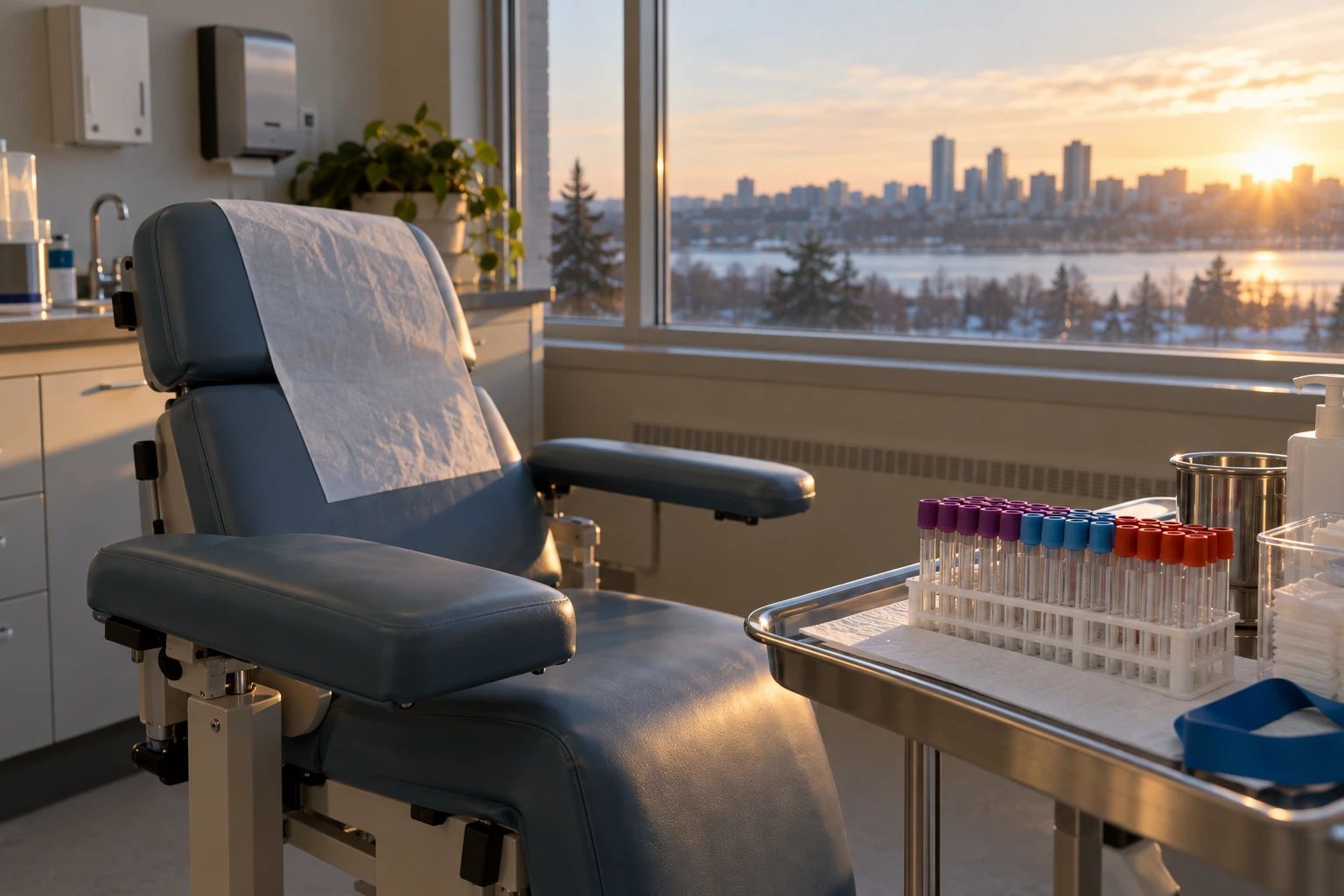
- Morning. Testosterone follows a daily rhythm. The European Association of Urology guideline specifies a fasting sample between 07:00 and 10:00.
- Fasting. Eating lowers measured testosterone, so the sample is taken before breakfast.
- Confirmed. A low reading is not treated as settled on its own. The Endocrine Society guideline asks for consistently low morning fasting total testosterone confirmed on repeat testing, and the Canadian product monograph for oral testosterone undecanoate, authorized 12 December 2025, asks for two separate validated biochemical assays on morning testosterone. How that confirmation is done in your case is a decision for your doctor or nurse practitioner.
- Not during acute illness. A level drawn during an infection, an injury or a hospital stay is not a reliable baseline.
What the numbers on the lab report mean, in nmol/L and ng/dL, with the reference ranges Canadian labs print, is on the testosterone levels page.
Canada publishes no single number that counts as low. The European Association of Urology guideline makes a strong recommendation for 12 nmol/L. The Canadian labels require deficiency to be demonstrated and confirmed without printing a threshold, which leaves the laboratory reference range and the clinician's judgement to carry that decision. The numbers each body uses, with dates, are set out in the guide on how low testosterone is diagnosed in Canada.

Finding the cause is part of the diagnosis
A low reading is a finding. What matters next is whether the testicles are not producing testosterone, or the signal from the pituitary is not arriving, or something reversible is suppressing the system. Follow-up tests usually include LH and FSH, often prolactin, and sometimes iron studies. Weight, untreated sleep apnea, opioid or steroid medication, heavy alcohol use and serious chronic illness can all lower testosterone, and addressing those comes before treatment in the European Academy of Andrology guidance on functional hypogonadism.
Can a symptom quiz diagnose low testosterone?
No. Questionnaires such as the ADAM (Androgen Deficiency in the Aging Male) questionnaire ask about symptoms, and the same symptoms have many other causes. The Canadian Urological Association says these questionnaires lack specificity and should not replace a history, an examination and blood work, though they can start a conversation. The Endocrine Society says the available questionnaires lack sufficient sensitivity and specificity, and suggests not using them to screen men seen for other reasons. In the original ADAM study of 316 Canadian physicians aged 40 to 62 (Morley 2000), the questionnaire identified 88% of men with low bioavailable testosterone but wrongly flagged many with normal levels; in 5,028 men aged 50 to 70 (Tancredi 2004), its specificity was 21.6%, and the authors concluded it cannot replace blood testing. This site has no quiz and collects no answers.
What should I ask at my appointment?
Before the appointment, write down:
- Your symptoms and when they started.
- Every medication and supplement you take, including any testosterone booster, and any anabolic steroid or testosterone used now or in the past.
- Your sleep, alcohol use and any change in weight.
- Any earlier testosterone results, with the time of day the blood was drawn.
- Whether you may want children, now or later.
Then take these questions with you:
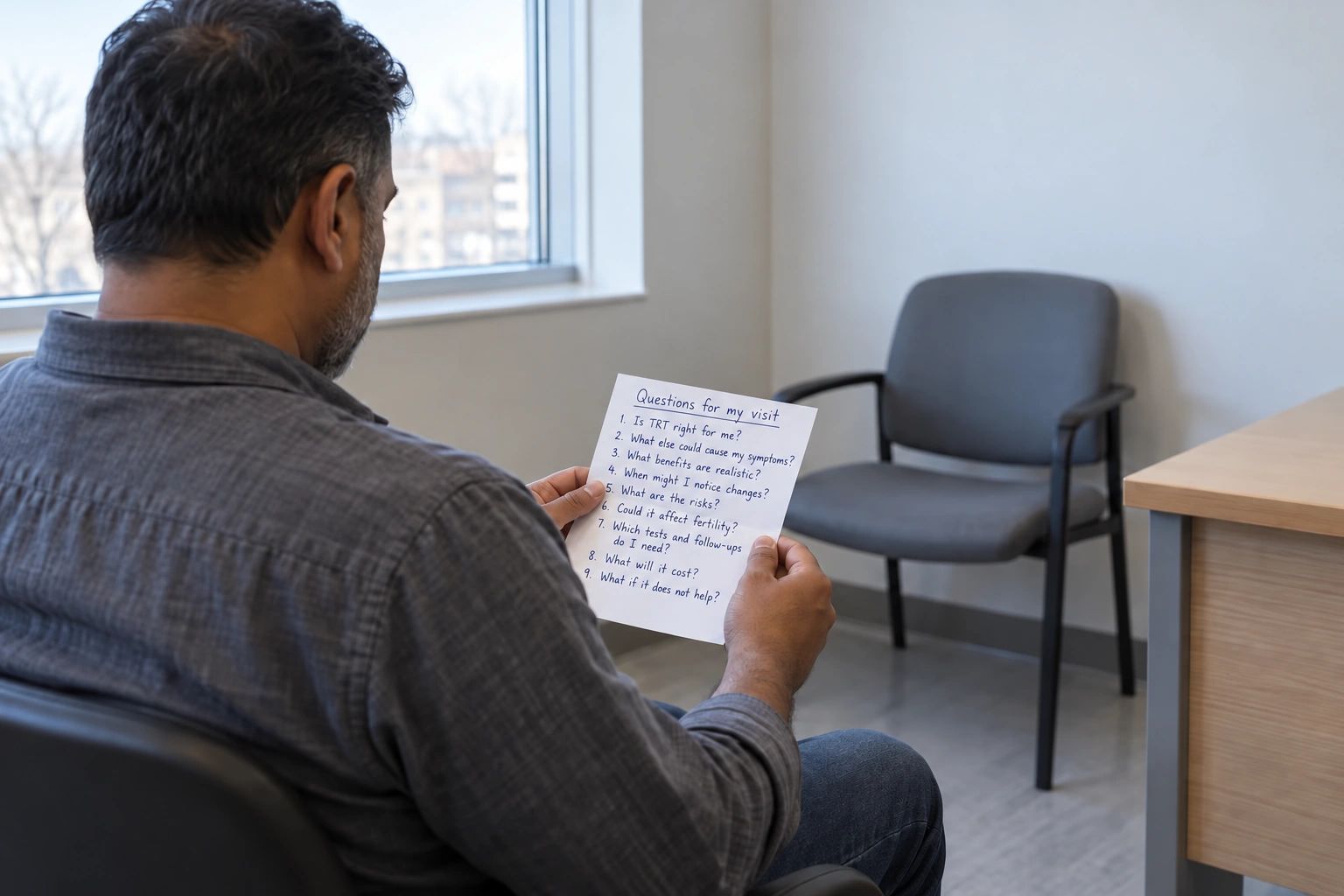
Print this page with your browser's print command, or copy the list into your phone. It is written to be answered by the clinician who has your results in front of them.
- What did my testosterone result actually say, and what time of day was the blood drawn?
- Was it a fasting sample, and will we need to repeat it?
- What else was tested: LH, FSH, prolactin, SHBG, ferritin, a blood count?
- Could something else explain how I feel: sleep, medication, alcohol, thyroid, iron, depression, weight, an untreated illness?
- If my level is low, do we know why it is low?
- What would we expect to change if I treated it, and what would not change?
- Am I planning to have children? How does that affect the decision?
- What monitoring would I need, how often, and who arranges it?
- What does this cost in my case, including the laboratory and the pharmacy?
- What happens if I stop?
Where assessment happens
Three routes, and they overlap.
- Your family doctor or nurse practitioner can order the blood work and prescribe. The visit and the test are publicly insured when ordered for a medical reason. If you have no regular provider, most provinces run an attachment registry (Saskatchewan does not yet), every province has a health advice line, and some run virtual primary care for unattached residents; those routes, by province, are on the access page.
- Online clinics assess by questionnaire, message or video, send a requisition, and charge their own fees. What each one publishes about its assessment, its fees and which provinces it lists is in the providers table.
- In-person TRT and specialist clinics see you face to face at a street address, and some also offer virtual appointments. Specialist referral runs through your doctor. Clinics with a verified address are in the same table.
The home page has a short comparison of online and in-person care: travel, appointment flexibility, physical examination, blood testing, continuity, costs and follow-up. Next: compare the providers, see what each charges, or go to your province.
Testosterone for trans men and for women
This site covers testosterone deficiency in men. Gender-affirming testosterone and testosterone for women are different questions with their own guidance and their own clinicians, and the provider comparisons here are not built for them.
- Gender-affirming care: Trans Care BC, a program of BC's Provincial Health Services Authority; Rainbow Health Ontario, including Sherbourne Health's guidelines for gender-affirming primary care; and, in Quebec, the health ministry's 2023 orientations on sexual and gender diversity (in French).
- Testosterone for women: the 2019 global consensus position statement (Davis and colleagues), endorsed by the Endocrine Society and The Menopause Society, supports it only for postmenopausal women with hypoactive sexual desire disorder after a full assessment, and advises against compounded products, pellets and injections.
Sources
- Testosterone therapy in men with hypogonadism, clinical practice guideline (Bhasin 2018), Endocrine Society, Journal of Clinical Endocrinology and Metabolism 103(5):1715-1744. Source date 1 May 2018. Checked 14 September 2026.
- Canadian Urological Association guideline on testosterone deficiency, Canadian Urological Association Journal. Source date 1 October 2021. Checked 14 September 2026.
- EAU guidelines on sexual and reproductive health, male hypogonadism, European Association of Urology. 2026 edition, limited update March 2026. Checked 14 September 2026.
- Information update: possible cardiovascular problems associated with testosterone products, Health Canada. Source date 15 July 2014. Checked 14 September 2026.
- Evaluation and management of testosterone deficiency, AUA guideline (Mulhall 2018), American Urological Association, Journal of Urology 200(2):423-432. Published 2018, reviewed and validity confirmed 2024. Checked 26 September 2026.
- Validation of a screening questionnaire for androgen deficiency in aging males (Morley 2000), Metabolism 49(9):1239-1242. Source date 1 September 2000. Checked 26 September 2026.
- Validity of the ADAM questionnaire in a population of men aged 50 to 70 (Tancredi 2004), European Journal of Endocrinology 151(3):355-360. Source date 1 September 2004. Checked 26 September 2026.
- Hormone therapy, Trans Care BC, Provincial Health Services Authority. No date shown. Checked 26 September 2026.
- Guidelines for gender-affirming primary care with trans and non-binary patients, 4th edition, Sherbourne Health, via Rainbow Health Ontario. No date shown. Checked 26 September 2026.
- Santé et bien-être des personnes de la diversité sexuelle et de la pluralité de genre, Ministère de la Santé et des Services sociaux du Québec. Source date 1 January 2023. Checked 26 September 2026.
- Global consensus position statement on the use of testosterone therapy for women (Davis 2019), Journal of Clinical Endocrinology and Metabolism 104(10):4660-4666. Source date 1 October 2019. Checked 26 September 2026.
- Testosterone testing protocol, BC Guidelines, Government of British Columbia. 2022 protocol. Checked 12 September 2026.